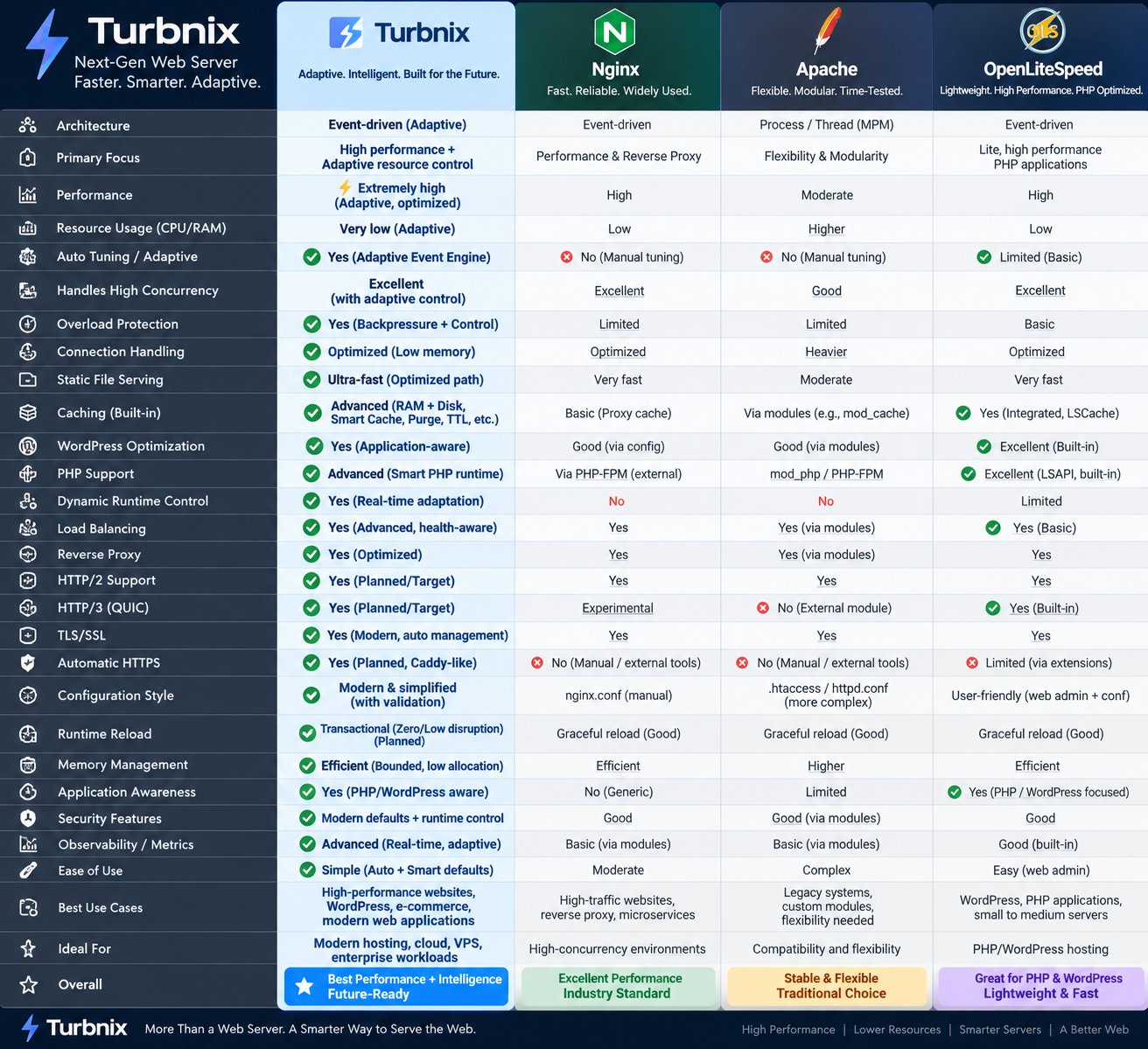
Adaptive Event Engine
The performance architecture starts with cheap per-worker counters and metrics. Aggregated snapshots can summarize CPU, RAM, active connections, request latency, queue depth, and runtime/PHP saturation without placing aggregation or control logic on the request or event-loop hot path.
These signals can inform admission control, concurrency limits, fairness, and overload response. Evaluation needs to measure instrumentation cost, decision stability, and recovery behavior alongside useful throughput. The controller is an architectural approach to validate, not evidence of a specific performance gain.
Large-System Efficiency
CPU locality, memory locality, NUMA awareness, and worker placement are architectural considerations for larger systems. Minimizing unnecessary cross-core coordination may reduce shared-state contention, but placement choices can also produce imbalanced work or remote memory access.
NUMA optimization is not presented as fully implemented. Planned profiling should compare placement strategies, identify coordination costs, and disclose topology and affinity settings. A technique should earn its place through measured benefit on the relevant hardware and workload, rather than through assumptions about scale.