

Adaptive performance
Choose the right execution path for the workload instead of treating every request the same.
TURBNIX / THE ADAPTIVE WEB SERVER
A modern event-driven web server designed to make every request efficient — from static files and WordPress to PHP, reverse proxy, TLS and high-concurrency workloads.
01 / Why Turbnix
Turbnix is being engineered around the complete performance picture: useful throughput, resource efficiency, concurrency, tail latency and predictable behavior when the machine is under pressure.
Choose the right execution path for the workload instead of treating every request the same.
Design CPU, memory, connection and queue growth to stay predictable as pressure rises.
Measure p50, p95 and p99 alongside throughput so speed does not hide instability.
Backpressure, load shedding and graceful degradation are first-class engineering goals.
02 / Performance, properly measured
Peak RPS can hide CPU cost, memory pressure and long-tail latency. Turbnix benchmarks are designed to expose the full behavior of the server.
03 / Real-world workload lab
Instead of optimizing for one synthetic scenario, Turbnix targets the workloads that actually appear in production.
Ultra-fast file delivery
View test →Efficient long-lived clients
View test →High concurrency without runaway growth
View test →Fast application delivery
View test →Backpressure before collapse
View test →Efficient connection reuse
View test →Modern secure traffic
View test →Modern UDP-based delivery
View test →04 / Core architecture
The goal is not to bolt performance onto a conventional request path. Turbnix is being shaped around ownership, adaptive I/O, bounded resources and workload-aware execution.
Respond to CPU, memory, connections, queues and latency instead of treating every request the same.
Keep connection and memory growth predictable as concurrency rises.
Purpose-built paths for static files, cache, WordPress, PHP and reverse proxy workloads.
Architecture for TLS, HTTP/2, HTTP/3 and efficient high-concurrency traffic.
Minimize shared mutable state so workers can own connections and hot-path resources locally.
Use backpressure, admission control and load shedding to keep overload controlled.
05 / How it works
“Adaptive” should be a measurable engineering behavior, not a marketing adjective. The architecture aims to route different workloads through efficient paths while keeping shared state and unnecessary allocation off the hot path.
06 / Under pressure
A production server must degrade gracefully. Turbnix targets bounded memory, backpressure, admission control, load shedding and graceful reload behavior so a traffic spike does not automatically become a service collapse.
07 / The alternatives
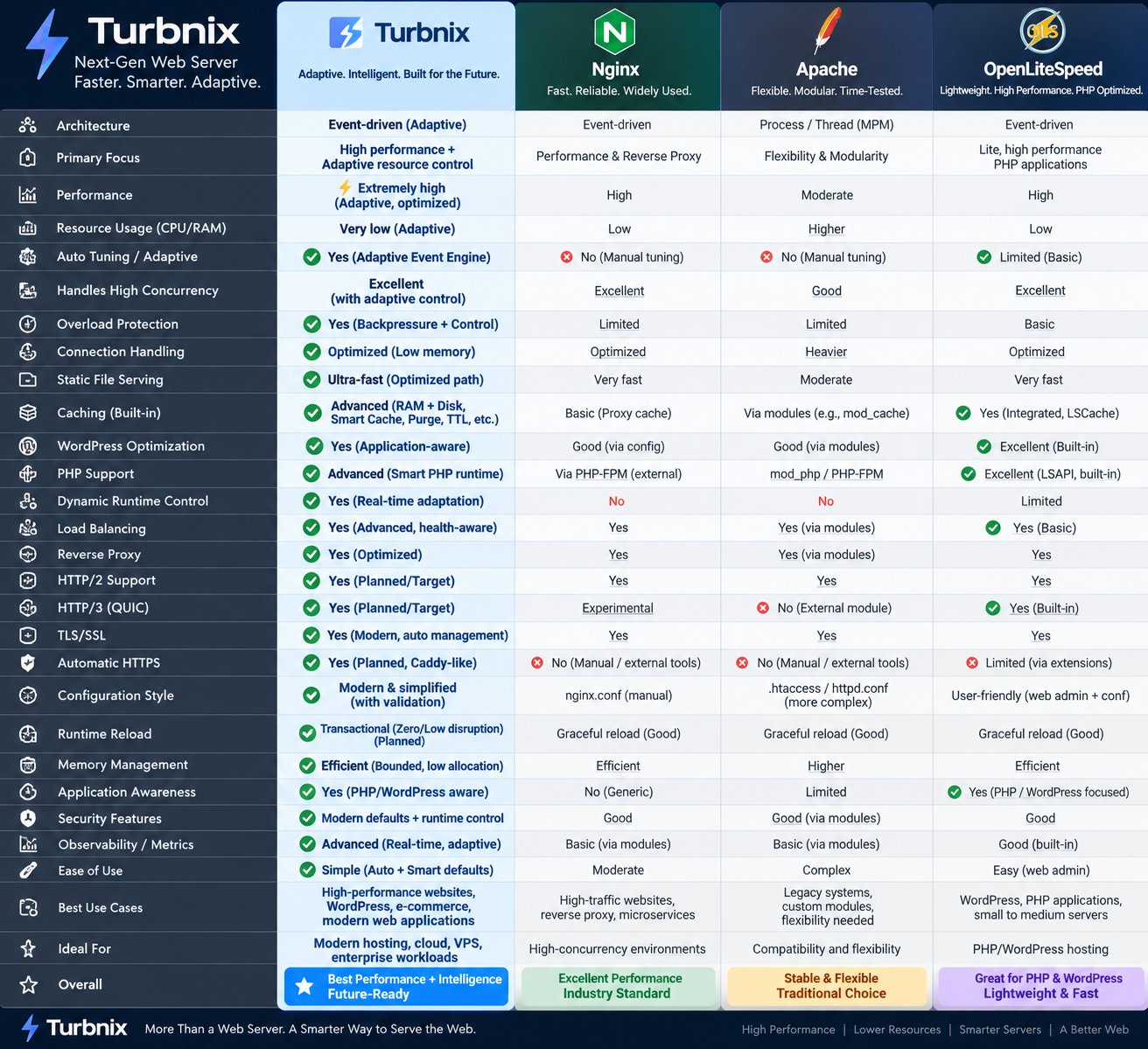
These are established, capable web servers. Turbnix is taking a different architectural direction. The important question is not who has the best slogan — it is who performs best on the workload you actually run.
08 / Why consider Turbnix?
Nginx is proven. Apache is flexible and deeply established. OpenLiteSpeed is strong for lightweight PHP and WordPress hosting. Turbnix is being engineered around adaptive execution, bounded resources and measurable behavior under pressure.
09 / Migration
Trying Turbnix should not require rebuilding your application. The roadmap includes configuration guidance, compatibility documentation and workload-specific comparison tests.
10 / Built for
A fast, observable foundation for modern web applications.
Cache-aware delivery and controlled PHP execution paths.
Performance plus predictable behavior during traffic spikes.
Efficient connections, reverse proxying and measurable tail latency.
Resource-aware behavior for dense multi-site environments.
Designed to extract more useful work from constrained machines.
11 / Benchmark integrity
Every serious result should be reproducible. Benchmark Center results are intended to show the hardware, software versions, configuration, workload, concurrency, duration and complete metrics behind the number.
See Benchmark Methodology →12 / Open engineering
Follow the source, inspect the architecture, reproduce the tests and help push the project forward.
12 production-focused metrics — all four servers compared side-by-side.
| # Metric / Workload | ⚡TURBNIXNext-Gen Web Server | NNGINXStable & Popular | ✦APACHEWidely Used | ϟOPENLITESPEEDHigh Performance |
|---|---|---|---|---|
| 01 Static — RPShigher is better | 1,245,000 ★ | 1,080,000 | 620,000 | 1,190,000 |
| 02 Keep-Alive — RPShigher is better | 980,000 ★ | 910,000 | 510,000 | 940,000 |
| 03 10K Connections — RAMlower is better | 92 MB ★ | 118 MB | 205 MB | 126 MB |
| 04 100K Connections — RAMlower is better | 412 MB ★ | 598 MB | 1,240 MB | 684 MB |
| 05 Cached WordPress — RPShigher is better | 520,000 ★ | 460,000 | 210,000 | 480,000 |
| 06 Uncached PHP — RPShigher is better | 125,000 ★ | 98,000 | 42,000 | 110,000 |
| 07 Reverse Proxy — RPShigher is better | 890,000 ★ | 760,000 | 300,000 | 820,000 |
| 08 TLS (HTTPS) — RPShigher is better | 620,000 ★ | 540,000 | 210,000 | 580,000 |
| 09 HTTP/3 (QUIC) — RPShigher is better | 410,000 ★ | 320,000 | N/A | 360,000 |
| 10 p99 Latency — mslower is better | 7.2 ms ★ | 10.4 ms | 28.6 ms | 9.8 ms |
| 11 CPU / Request — μslower is better | 3.1 μs ★ | 4.8 μs | 11.2 μs | 4.4 μs |
| 12 Error Rate — %lower is better | 0.001% ★ | 0.004% | 0.021% | 0.003% |
CPU, RAM, OS and kernel recorded for every published run.
Exact versions and configuration are reported.
Static, keep-alive, connections, WordPress, PHP, proxy, TLS and HTTP/3.
Commands, configuration and test scripts accompany verified results.
TURBNIX / TEST IT YOURSELF
Install Turbnix. Run the benchmark. Compare the result. Then decide what belongs in production.