

TURBNIX ENGINEERING SERIES · POST #04
Performance ≠ RPS
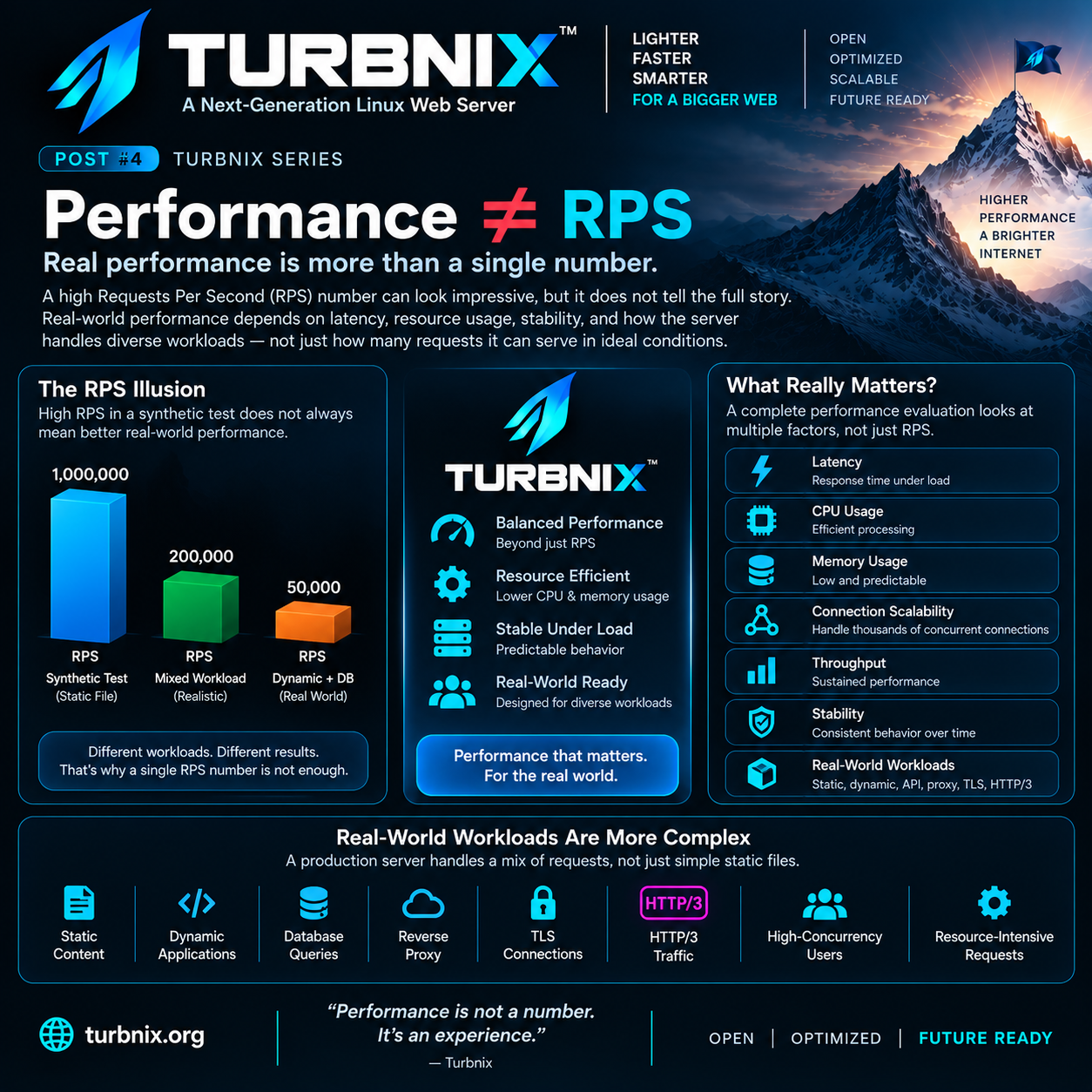
Shows why requests per second alone cannot describe real server performance.
SOURCE CONTENT
From the original Engineering Series
This page preserves the topic and technical direction represented by the original artwork. The historical LinkedIn draft text is not reproduced as an exact quotation where the original standalone draft is unavailable.
EXPANDED TECHNICAL EXPLANATION
Performance ≠ RPS
A useful performance model combines throughput with p50/p95/p99 latency, CPU per request, memory usage, connection capacity, error rate and workload type. A server that posts a high RPS number but becomes unstable under sustained load is not necessarily faster in production.
ENGINEERING NOTE
Ideas first. Evidence next.
Turbnix engineering claims should ultimately be validated with reproducible tests. Design goals, early observations and measured production results are kept distinct so the project can improve from evidence rather than assumptions.